Operative
Labourers, trainees and skilled trades
- Green · Labourer
- Red · Trainee / Apprentice
- Blue · Skilled Worker
- Gold · Advanced Craft
 CSCS Mock Test
50 CSCS test questions with answers, on the health, safety and environment topics of the CITB HS&E test. Answer one at a time and see the explanation straight away, with a link to the official page it was checked against. Your score comes at the end. No sign-up.
Question 1 of 50 · Health, Safety & Welfare Law
Not quite.
Section 7 requires employees to take reasonable care of their own health and safety and that of others who may be affected by their acts or omissions.
Checked against Health and Safety at Work etc. Act 1974, section 7
Question 2 of 50 · Health, Safety & Welfare Law
Not quite.
CDM 2015 requires notification to the HSE when the construction work will last longer than 30 working days with more than 20 workers simultaneously, or exceed 500 person-days.
Checked against CDM Regulations 2015, regulation 6
Question 3 of 50 · Health, Safety & Welfare Law
Not quite.
LOLER requires thorough examination at least every 12 months, or every 6 months for equipment used for lifting persons, or in accordance with an examination scheme.
Checked against LOLER 1998, regulation 9
Question 4 of 50 · Health, Safety & Welfare Law
Not quite.
The principal contractor has the duty to plan, manage and monitor the construction phase, ensuring it is carried out safely.
Checked against CDM Regulations 2015, regulation 13
Question 5 of 50 · Health, Safety & Welfare Law
Not quite.
An employer with 5 or more employees must have a written health and safety policy as required by the Health and Safety at Work Act 1974.
Checked against HSE: health and safety policy
Question 6 of 50 · Accident Reporting & Recording
Not quite.
Under RIDDOR, any accident that results in more than 7 consecutive days of incapacitation must be reported.
Checked against HSE: types of reportable incidents (RIDDOR)
Question 7 of 50 · Accident Reporting & Recording
Not quite.
Specified injuries including fractures (except to fingers, thumbs, or toes), amputations, and loss of consciousness must be reported under RIDDOR.
Checked against HSE: types of reportable incidents (RIDDOR)
Question 8 of 50 · Accident Reporting & Recording
Not quite.
The collapse or partial collapse of scaffolding over 5 metres is a RIDDOR reportable dangerous occurrence.
Checked against HSE: RIDDOR dangerous occurrences
Question 9 of 50 · Accident Reporting & Recording
Not quite.
Over-7-day incapacitation injuries must be reported within 15 days of the accident using the online RIDDOR reporting form.
Checked against RIDDOR 2013, regulation 4
Question 10 of 50 · Manual Handling
Not quite.
The Manual Handling Operations Regulations 1992 require employers to avoid, assess, and reduce the risk of injury from manual handling.
Checked against HSE: manual handling and the law
Question 11 of 50 · Manual Handling
Not quite.
HSE guidelines suggest starting forces of about 20 kg for men and 15 kg for women, with lower sustained forces of about 10 kg and 7 kg respectively.
Checked against HSE: assessing pushing and pulling
Question 12 of 50 · Manual Handling
Not quite.
If manual handling cannot be avoided, Regulation 4(1)(b)(i) requires the employer to make a suitable and sufficient assessment of those operations.
Checked against Manual Handling Operations Regulations 1992, regulation 4
Question 13 of 50 · Health & Welfare Hazards
Not quite.
Silicosis is a lung disease caused by inhaling fine crystalline silica dust, commonly produced when cutting, drilling, or grinding concrete, stone, or brick.
Checked against HSE: silica dust in construction
Question 14 of 50 · Health & Welfare Hazards
Not quite.
Legionnaires' disease is a potentially fatal pneumonia caused by inhaling water droplets containing Legionella bacteria, which can grow in stagnant water systems, cooling towers, and showers.
Checked against HSE: what is Legionnaires' disease
Question 15 of 50 · Health & Welfare Hazards
Not quite.
Occupational dermatitis is skin inflammation caused by contact with substances at work such as cement, solvents, oils, and adhesives.
Checked against HSE: causes of skin problems at work
Question 16 of 50 · Noise & Vibration
Not quite.
The ELV of 5 m/s2 A(8) is the maximum daily hand-arm vibration exposure and must not be exceeded. If it is exceeded, immediate action must be taken to reduce exposure.
Checked against Control of Vibration at Work Regulations 2005, regulation 4
Question 17 of 50 · Noise & Vibration
Not quite.
The exposure limit value is 87 dB(A), taking into account the effect of hearing protection. This must not be exceeded.
Checked against HSE: the Control of Noise at Work Regulations
Question 18 of 50 · Noise & Vibration
Not quite.
The Control of Vibration at Work Regulations 2005 implement EU Directive 2002/44/EC and require employers to eliminate or reduce risks from hand-arm and whole-body vibration.
Checked against HSE: whole-body vibration and the law
Question 19 of 50 · Hazardous Substances
Not quite.
Under COSHH Regulation 9 and HSE guidance HSG258, LEV systems must be thoroughly examined and tested at least every 14 months. Records of examinations must be kept for at least 5 years. Regular visual checks and maintenance should also be carried out between formal examinations to ensure the system continues to work effectively.
Checked against HSE: local exhaust ventilation FAQs
Question 20 of 50 · Hazardous Substances
Not quite.
The control limit under the Control of Asbestos Regulations 2012 is 0.1 fibres per cm³ of air averaged over a continuous 4-hour period.
Checked against HSE: asbestos FAQs
Question 21 of 50 · Hazardous Substances
Not quite.
Under the Control of Lead at Work Regulations 2002, the blood lead suspension level is 60 µg/dl for men and 30 µg/dl for women of reproductive capacity.
Checked against HSE: lead exposure
Question 22 of 50 · Hazardous Substances
Not quite.
COSHH stands for Control of Substances Hazardous to Health Regulations 2002.
Checked against COSHH Regulations 2002
Question 23 of 50 · Hazardous Substances
Not quite.
The exclamation mark GHS pictogram indicates the substance is harmful if swallowed/inhaled, causes skin or eye irritation, causes allergic skin reaction, or is a respiratory irritant.
Checked against HSE: hazard symbols and hazard pictograms
Question 24 of 50 · Personal Protective Equipment
Not quite.
Facial hair (stubble, beard) prevents a proper seal between the face and the RPE, allowing contaminated air to leak in around the edges, reducing protection significantly.
Checked against HSE: face fit testing basics
Question 25 of 50 · Personal Protective Equipment
Not quite.
At 85 dB(A) (upper EAV), employers must provide hearing protection and enforce its use. At 80 dB(A) (lower EAV), protection must be made available.
Checked against HSE: the Control of Noise at Work Regulations
Question 26 of 50 · Personal Protective Equipment
Not quite.
PPE should always be considered the last resort in the hierarchy of control, used only when risks cannot be adequately controlled by other means.
Checked against HSE: the PPE at Work Regulations
Question 27 of 50 · Fire Prevention & Control
Not quite.
The responsible person has legal duties under the Fire Safety Order 2005, including carrying out fire risk assessments and implementing fire precautions.
Checked against Regulatory Reform (Fire Safety) Order 2005, article 3
Question 28 of 50 · Fire Prevention & Control
Not quite.
Fire risk assessments are required under the Regulatory Reform (Fire Safety) Order 2005. They must identify hazards, evaluate risks, and record findings and actions.
Checked against GOV.UK: fire risk assessments
Question 29 of 50 · Fire Prevention & Control
Not quite.
DSEAR defines an explosive atmosphere as a mixture of dangerous substances with air that, once ignited, can propagate (spread) through the remaining mixture.
Checked against DSEAR 2002, regulation 2
Question 30 of 50 · Fire Prevention & Control
Not quite.
Your first action on discovering a fire should be to raise the alarm to warn others. Then evacuate and call the fire brigade.
Checked against GOV.UK: making small non-domestic premises safe from fire
Question 31 of 50 · Electrical Safety
Not quite.
Regulation 14 requires that work on dead equipment is the default. Live working is only permitted when it is unreasonable to work dead, with precautions to prevent injury. The test in Regulation 14 is strict: it must be unreasonable in all circumstances for the equipment to be dead, reasonable in all circumstances to work on or near it live, and suitable precautions must be taken to prevent injury.
Checked against Electricity at Work Regulations 1989, regulation 14
Question 32 of 50 · Electrical Safety
Not quite.
Regulation 4(2) of the EWR 1989 requires all electrical systems to be maintained so as to prevent danger, so far as is reasonably practicable.
Checked against Electricity at Work Regulations 1989, regulation 4
Question 33 of 50 · Signs & Signals
Not quite.
Prohibition signs are round with a red border and diagonal cross-bar on a white background.
Checked against Safety Signs and Signals Regulations 1996, schedule 1
Question 34 of 50 · Signs & Signals
Not quite.
Under the Health and Safety (Safety Signs and Signals) Regulations 1996, the LOWER signal is the right arm pointing downwards with the palm facing inwards, slowly making a circle. This is distinct from the RAISE signal, where the right arm points upwards with the palm facing forward, slowly making a circle.
Checked against Safety Signs and Signals Regulations 1996, schedule 1
Question 35 of 50 · Signs & Signals
Not quite.
The Regulations require safety signs where risk assessment identifies a significant risk and other control measures do not adequately reduce the risk.
Checked against Safety Signs and Signals Regulations 1996, regulation 4
Question 36 of 50 · Working at Height
Not quite.
The Work at Height Regulations 2005 define work at height as any place where a person could fall a distance liable to cause personal injury, including work at ground level near an excavation.
Checked against HSE: working at height
Question 37 of 50 · Working at Height
Not quite.
The Work at Height Regulations require the top guard rail to be at least 950 mm above the edge from which a person could fall.
Checked against HSE: scaffolding
Question 38 of 50 · Working at Height
Not quite.
The hierarchy is: (1) avoid work at height, (2) prevent falls using equipment like guard rails, (3) minimise the distance and consequences of a fall.
Checked against HSE: working at height
Question 39 of 50 · Excavations & Confined Spaces
Not quite.
Excavations must be inspected by a competent person at the start of each shift, after any event that may affect stability, and after any accidental fall of material into the excavation.
Checked against HSE: excavations
Question 40 of 50 · Excavations & Confined Spaces
Not quite.
Regulation 4(1) requires that no person enters a confined space unless it is not reasonably practicable to achieve the purpose without entry.
Checked against HSE: confined spaces and the law
Question 41 of 50 · Excavations & Confined Spaces
Not quite.
Battering (or sloping) the sides to a stable angle reduces the risk of collapse. The required angle depends on soil type and conditions.
Checked against HSE: excavations
Question 42 of 50 · Demolition & Plant
Not quite.
Any building constructed before 2000 may contain asbestos. A Refurbishment and Demolition (R&D) asbestos survey must be carried out before demolition or refurbishment work begins.
Checked against HSE: arranging an asbestos survey
Question 43 of 50 · Demolition & Plant
Not quite.
Licensed asbestos work includes removal of asbestos insulation, sprayed coatings, and asbestos insulating board. The licence is granted by the HSE.
Checked against HSE: applying for an asbestos licence
Question 44 of 50 · Demolition & Plant
Not quite.
LOLER places duties on employers to ensure lifting equipment is strong enough, stable, positioned safely, and subject to regular thorough examination.
Checked against Lifting Operations and Lifting Equipment Regulations 1998
Question 45 of 50 · Environmental Awareness
Not quite.
Section 79 of the EPA lists categories of statutory nuisance. Examples include excessive noise, dust or odour from a construction site. Local authorities can serve abatement notices to require the nuisance to be stopped.
Checked against Environmental Protection Act 1990, section 79
Question 46 of 50 · Environmental Awareness
Not quite.
Under the duty of care, anyone who produces, imports, keeps, stores, transports, treats, or disposes of waste must take reasonable measures to prevent its escape, ensure proper handling, and transfer only to authorised persons. The aim of these measures is to prevent the waste causing pollution.
Checked against Environmental Protection Act 1990, section 34
Question 47 of 50 · Environmental Awareness
Not quite.
Under Section 61 of the Control of Pollution Act 1974, contractors can apply to the local authority for prior consent for construction work, agreeing how noise and vibration will be controlled.
Checked against Control of Pollution Act 1974, section 61
Question 48 of 50 · Waste Management
Not quite.
The waste hierarchy (most to least preferred): 1) Prevention, 2) Preparing for reuse, 3) Recycling, 4) Other recovery (e.g., energy), 5) Disposal. Construction must follow this hierarchy.
Checked against Waste (England and Wales) Regulations 2011, regulation 12
Question 49 of 50 · Waste Management
Not quite.
Hazardous waste requires consignment notes under the Hazardous Waste (England and Wales) Regulations 2005, with more detailed waste descriptions. A consignment note records more detailed information than the standard waste transfer note used for non-hazardous waste.
Checked against GOV.UK: hazardous waste consignment notes
Question 50 of 50 · Waste Management
Not quite.
Waste transfer notes create a paper trail (audit trail) that enables enforcement and demonstrates compliance with Duty of Care. They must include the EWC code, the quantity, the producer's and carrier's details, the carrier's registration number and the date of transfer.
Checked against Waste (England and Wales) Regulations 2011, regulation 35
They are the CSCS Mock Test app's own exam-style questions, not questions from the real test. Before a question goes on this page, its answer and every fact in its explanation are read on an official page — HSE, GOV.UK or the law itself on legislation.gov.uk — and that page is linked under the explanation. Questions that can't be checked that way stay off.
The real test is 50 questions in 45 minutes, and you need 45 right to pass. The app has full 50-question timed mocks, including case studies and image questions, built from 3,000+ questions — and your first full mock is free.
CSCS Mock Test 2026Walk in ready.Pass first time.Realistic mock exams for the CITB Health, Safety & Environment test — 3,000+ practice questions, every answer explained, in your own language.
Rated 4.6 · 950+ ratings on the App Store and Google Play
Pass mark
45 / 50
50
questions in the real test
How Many Questions Are in the CSCS Test? →45
minutes to finish
45/50
to pass — that's 90%
What Is the CSCS Test Pass Mark? →3,000+
practice questions in the app
Not just a pile of questions — the tools that turn practice into a pass.
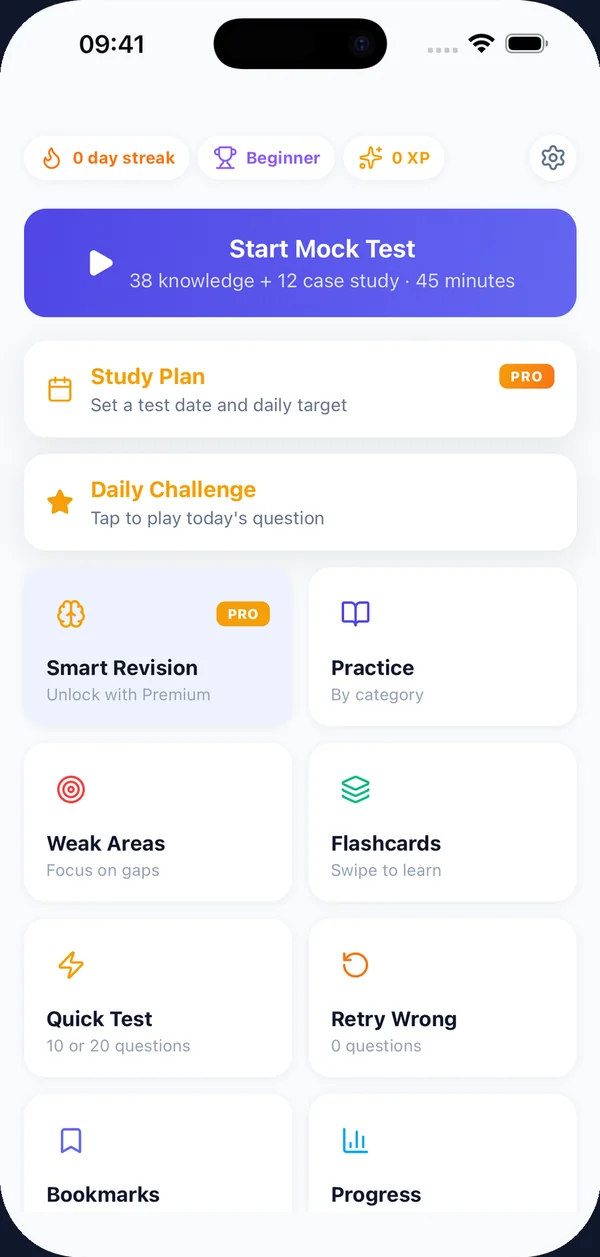
50 questions in 45 minutes with a 45/50 pass mark, like the real test. Each mock mixes 38 knowledge questions with 12 behavioural case-study questions.
The app spots the topics you keep getting wrong and drills those first.
Swipe through the facts you have to know cold — signs, numbers, regulations.
One question a day keeps it fresh. Build a streak, earn XP, level up.
Set your test date and get a daily target that gets you ready in time.
Ten minutes on a break? Run a short test, or re-sit only the ones you missed.
Save the tricky questions and come back to them before test day.
Revise on site, on the train, or anywhere without a signal.
See your scores by topic and watch them climb toward the pass mark.
Practise a topic, sit a test, see where you stand — then do it again until 45 out of 50 is routine.
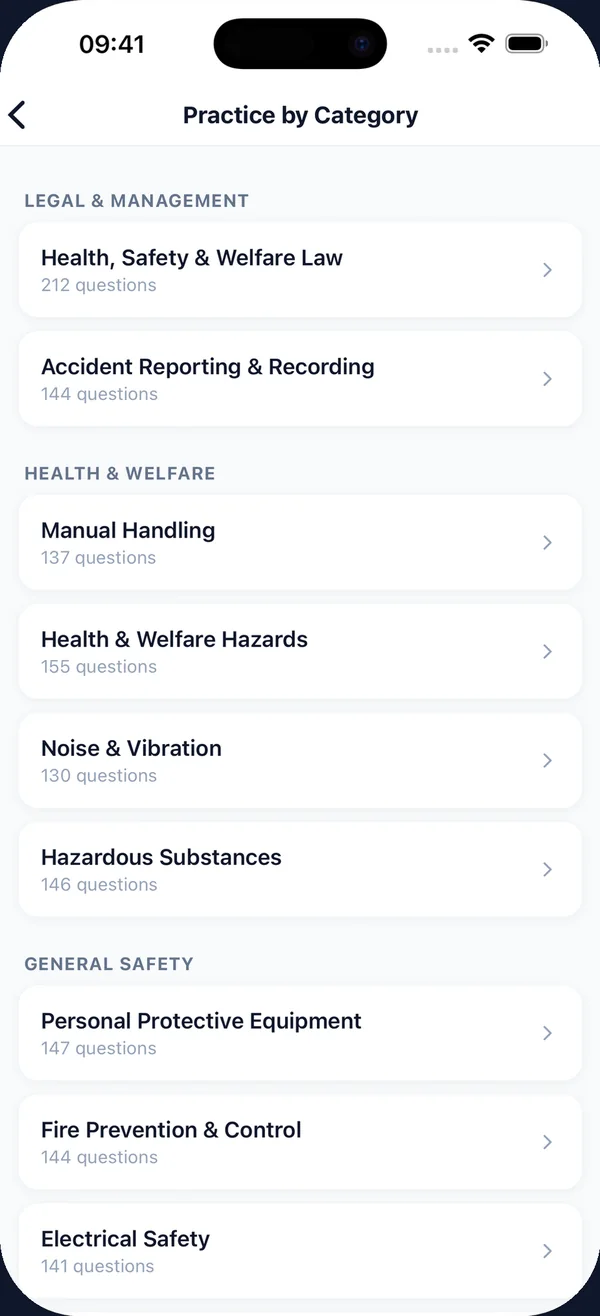
Every topic on the test, from manual handling to electrical safety — with a question count for each.
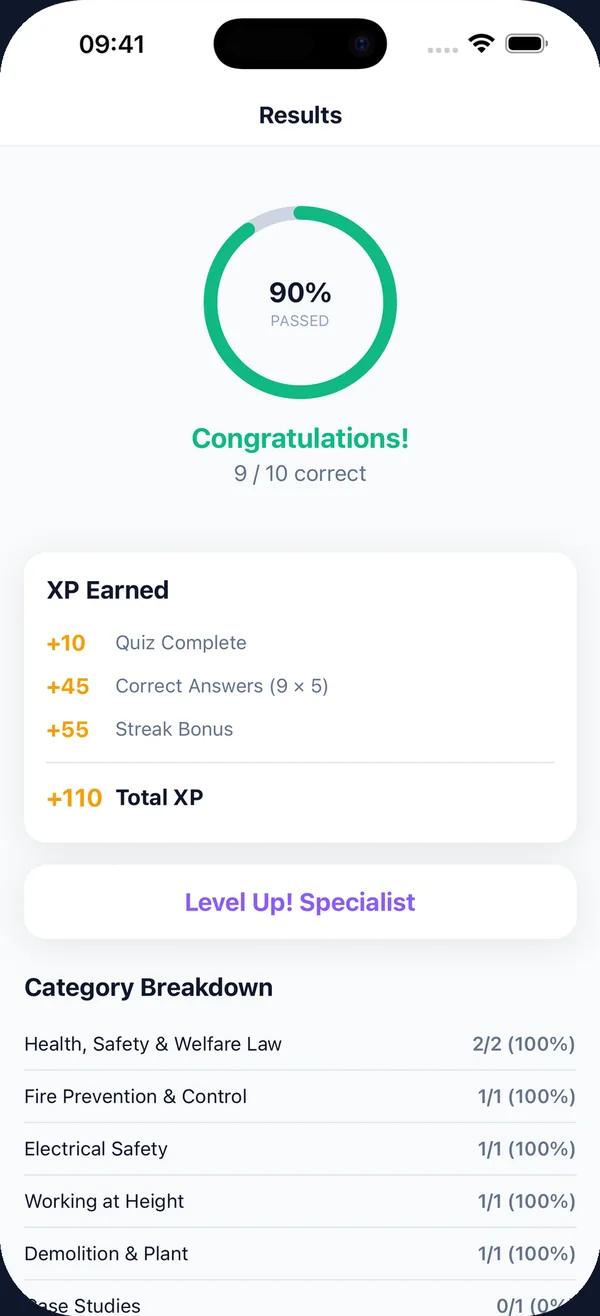
Your score, whether it's a pass, and a topic-by-topic breakdown after every test.

Every test you've taken, with your score, time and pass or fail.
Every question, every answer and every explanation is translated — all 3,000+ of them. Learn the safety rules in the language you think in, and switch whenever you like.
Your card's colour decides your test. All three have the same shape — 50 questions, 45 minutes, 45 to pass — and the app has the right question pool for each.
Labourers, trainees and skilled trades
Supervisors and high-risk specialist trades
The core test plus one of 12 specialisms — working at height, demolition, highway works, plumbing, tunnelling, lifts, HVAC and more.
Site managers, engineers, architects and surveyors
Green card mock test →Blue card mock test →Gold card mock test →Black card mock test →CSCS Card Types and Colours Explained →
CITB says the Operatives test covers five core knowledge areas: working environment, occupational health, safety, high risk activities and specialist. The Specialist tests add questions on your chosen specialism, and the Managers and Professionals test covers similar ground at management level. The 50 questions in this test come from 15 topics within it:
Everything you need to know about the CSCS card and the CITB Health, Safety and Environment test — pass marks, card types, booking, and revision tips.
The CSCS test has 50 questions and lasts 45 minutes. Here's how the questions break down, what types to expect, and how many you can get wrong.
The CSCS test pass mark is 45 out of 50 (90%) for every version — Operative, Specialist, and Managers & Professionals. Here's what that means in practice.
Green, red, blue, gold, black, and white CSCS cards explained — what each colour means, who needs which card, and the qualifications required.
Book the CITB Health, Safety and Environment test in 4 steps: it costs £23.50, takes 45 minutes, and you'll need photo ID on the day. Here's the process.
About 3 in 4 pass — CITB put the Managers & Professionals pass rate at 74% — but the 90% pass mark leaves little room for error. How to prepare.
Most CSCS cards last 5 years — but first-issue green Labourer cards now last 2 years, and most red cards can't be renewed. Full validity guide.
Get a green CSCS Labourer card in 3 steps: complete a Level 1 health and safety award, pass the CITB Operatives test (£23.50), and apply for the card (£36).
Seven practical tips to pass the CSCS test on your first attempt — from mastering the interactive question formats to knowing when you're actually ready to book.
Renew a CSCS card in the My CSCS app from six months before it expires. You need an HS&E test pass from the last two years and the £36 fee. Full rules.
A CSCS card costs £36 (£42 from February 2027) and the CITB test £23.50, so £59.50 for both. What else you may pay: courses, re-sits and renewals.
The CITB Health, Safety and Environment test explained: the three versions, 50 questions in 45 minutes, the 45/50 pass mark, booking for £23.50 and how to prepare.
Sit your first full mock test free and see your real score.